Examining challenges to the narrative of rapid and sustained AI electricity demand growth
Over the course of human history, there have been a lot of can’t-miss trends that did, in fact, miss. And the surest sign you’re in a bubble is that you hear people talking about the trend in question using certain phrases:
“As we all know”
“It’s obvious that”
“McKinsey says”
You get the idea. From Dutch tulips to mortgage-backed securities to skinny jeans, generally, when we reach a point at which everyone agrees an economic or business phenomenon is a no-brainer money-printing machine or an irreversible societal trend that will go on forever... it doesn't. Hockey-stick growth is rarely, if ever, sustainable over years and decades, with the unfortunate exception of atmospheric CO2 concentrations since 1958 (yikes).
I’m not going to try to convince you that the growth of AI is a scam. Nor am I going to try to convince you that the near-term expansion of data center capacity to support the near-term growth of AI is a myth. Heck, I won’t even try to convince you that the projected rapid growth in electricity demand required to power that new data center capacity is a fantasy. Nor will I be so bold as to tell you that we’ll see reach the “peak of inflated expectations” and see the bubble burst this year, or next, or the following. To definitively assert any of the above would convey a level of certainty that I absolutely lack. But here’s what I do think is likely: Over the next ten years,we will see significantly lower electricity demand growth from AI-driven data center buildout than what most market observers are currently projecting.
What the Experts* Say
What are those growth projections? To keep it brief, here are a few big headline numbers folks are throwing around (all for the US market):
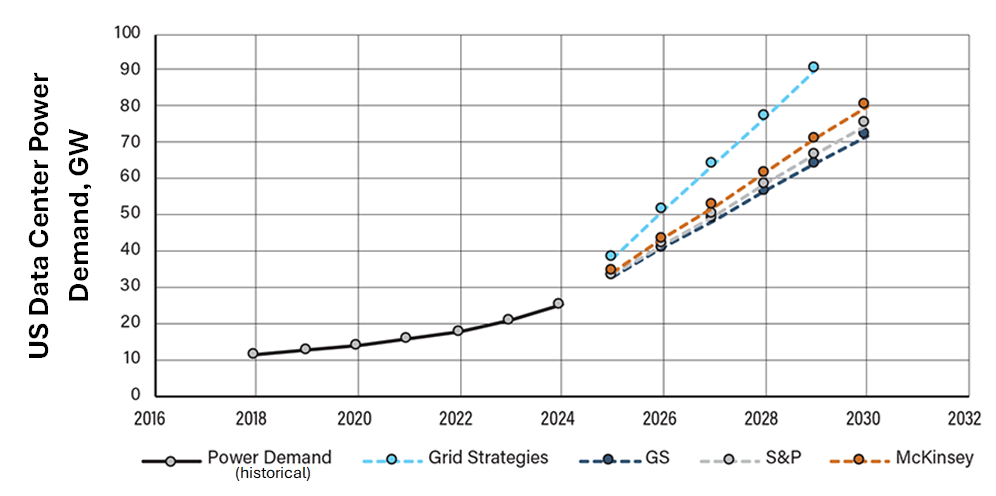
Goldman Sachs has data center electricity demand increasing at a 16% compound annual growth rate (CAGR) from 2023 through 2030, contributing 90 bps toward an overall 2.4% CAGR during that period for total US electricity demand.
McKinsey says (see above 😉) that data center electricity demand will increase from 178 terawatt-hours in 2024 to over 600 TWh in 2030, a 22.6% CAGR, meaning data centers’ contribution to total electricity demand would almost triple from 4.3% to 11.7% in that time.
Deloitte states that while topline data center demand is expected to grow more than fivefold in the next decade, AI’s share of this will grow much faster: AI accounted for about 12% of data centers’ 33 GW of power demanded in 2024, but they claim this will explode to 70% of a total 176 GW demanded in 2035.
*Meaning the bankers and consultants. Up to you whether or not to read any sarcasm into this word choice.
Energy industry veterans, feel free to skip the following two paragraphs on energy vs. load.
Before we go further: These estimates are not apples-to-apples in that the Goldman and McKinsey figures predict energy consumption, or the area under the curve, in terawatt-hours, while the Deloitte figures predict load, or instantaneous power draw, in gigawatts. For data centers, whose utilization rate is fairly constant, i.e. their instantaneous power draw is relatively steady over time, we can make some basic assumptions that load translates fairly linearly to energy consumption over a certain period of time, but just know there is technically a distinction between a gigawatt, which is a rate of power consumption, and a terawatt-hour, which is a quantity of energy consumed, specifically the amount consumed when you power a gigawatt of load for a thousand hours.
All of this to say that it’s possible for load, specifically peak load (the highest recorded instantaneous power draw of a system) to increase while energy consumption stays the same or even drops, or vice versa – but in the case of data centers, we can pretty safely assume that load and energy consumption move together. To be clear, when I refer to “electricity demand” or “power demand” throughout this blog, I am using that as an umbrella term to capture both load and energy consumption, because, again, given the operational patterns of data center, growth in one equates to growth in the other.
Folks skipping the energy vs. load refresher, keep reading from here.
Need a simple visual on what these demand growth projections look like? Here’s a handy chart from NRUCFC, a financial services co-op that lends to rural electric utilities: Source: https://www.nrucfc.coop/content/solutions/en/stories/energy-tech/data-center-demand-accelerates-in-recent-forecasts.html, with minor additions to y-axis and legend. If you read the prior two paragraphs, here's an opportunity to reinforce your new knowledge: The y-axis units here are gigawatts, telling us the what’s characterized as “demand” here is load, not energy consumption. Sorry, Deloitte bros – your forecasts didn’t make the cut. Anyway... The consensus view is pretty clear: Data centers’ electricity demand is headed up, up, up. The natural deduction, also a consensus view, is that this is bullish for the power sector: More demand means higher prices means a stronger economic signal to build new generation and print easy money by serving this step-change in all-hours demand.
What needs to happen for this scenario to play out the way these market observers expect? First, let’s establish a basic formula for the annual electricity use of AI, which we can call E_AI:
E_AI = AI Tasks/Year * Compute/AI Task * Energy/Compute
Now, I’m deliberately being very vague in the first two terms of the equation’s right side, because “tasks” could pertain to either AI training or inference. In layperson’s terms, training is building and fine-tuning the AI model, while inference is using it once it’s built. The thinking is generally that while training accounts for more of AI compute needs today, the vast majority of AI compute will eventually be required for inference, as AI companies figure out how to make model training more efficient (see below regarding DeepSeek R1) and how to monetize the end product such that they can make money off of the inference queries submitted by users.
Regardless of the split between training and inference, all four of the following statements must be true to some extent for electricity demand to spike in the coming years as a result of AI-driven data center growth:
Demand for AI itself (ChatGPT queries, AI agents, AI-enhanced Google searches, etc) continues to grow rapidly
Demand for data center compute to perform these AI functions continues to grow rapidly
Demand for electricity to power this data center compute continues to grow rapidly
The resulting AI-driven electricity demand growth driven by the prior three statements forms a substantial share of overall electricity demand growth
Let’s take these one at a time and explore how each statement could turn out to be false, such that the AI boom does not drive substantially higher electricity demand growth.
What If: AI revenue fails to grow to a huge absolute annual run-rate figure, sufficient to enable recovery of and return on AI players’ massive data center capex and opex?
How can AI companies actually bring in enough revenue to justify all of their data center capex and opex? David Cahn of Sequoia Capital has done a great of explaining the hill to climb for AI companies seeking profitability:
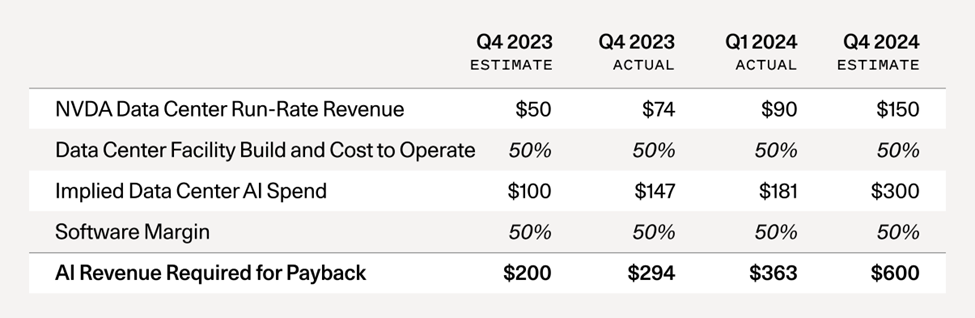
Consider the following: For every $1 spent on a GPU, roughly $1 needs to be spent on energy costs to run the GPU in a data center. So if Nvidia sells $50B in run-rate GPU revenue by the end of the year (a conservative estimate based on analyst forecasts), that implies approximately $100B in data center expenditures. The end user of the GPU—for example, Starbucks, X, Tesla, Github Copilot, or a new startup—needs to earn a margin too. Let’s assume they need to earn a 50% margin. This implies that for each year of current GPU CapEx, $200B of lifetime revenue would need to be generated by these GPUs to pay back the upfront capital investment. This does not include any margin for the cloud vendors—for them to earn a positive return, the total revenue requirement would be even higher.
This very simple and helpful explanation came in a September 2023 blog post titled, “AI’s $200B Question.” Then, nine months later, Cahn updated this calculation to reflect Nvidia’s expected Q4 2024 run-rate GPU revenue of $150B, making AI revenue requirements a $600B Question. Here is that updated calculation in tabular form: Source: David Cahn/Sequoia, https://www.sequoiacap.com/article/ais-600b-question/ Where are we today? Nvidia’s most recent earnings report on May 28, 2025 showed $39.1B in data center revenue, for an annual run-rate of $156.4B, implying a payback revenue need of about $626B using Cahn’s method. We could get more granular with the assumptions to zoom in on the actual amount of revenue required to create standard software gross margins for different AI firms, but the point is that a ton of capex is flowing out the door with no guarantee – indeed, not even any particularly strong evidence at this point – that consumers or businesses are willing to pay enough for existing AI applications and use cases to make this big industry-wide infrastructure bet pay off.
I’m not saying that AI will never create and capture sufficient value to pay for the infrastructure it needs, just that a meaningful lag seems likely between when all these data centers are built and when the AI product is good enough to start printing cash. In that time, the balance sheets of even big, well-capitalized players, and the patience of their shareholders, could well be tested by all this data center capex, and demand (or at least monetizable demand – i.e. willingness-to-pay) for AI products and services may never reach the levels implied by the scale of the current hyperscale data center buildout.
What happens then? Well, you’ll either have a ton of shiny new AI data centers sitting around with not enough to do, such that each individual asset will see a much lower utilization rate than its owner underwrote when constructing it, or data center owners will consolidate utilization among their best-performing data centers, and sell or scrap all the rest as stranded assets whose compute capacity is surplus to requirements. For energy project developers, the macro outcome is the same – you’ve built a lot of new energy generation and storage assets to serve a source load growth that turned out to be much weaker than expected, and the lack of revenue AI companies are pulling in begets a lack of budget to keep paying for and operating the data centers that were supposed to be buying electricity from your projects.
What If: Demand for compute fails to continue growing rapidly as AI model training and inference become far more compute-efficient?
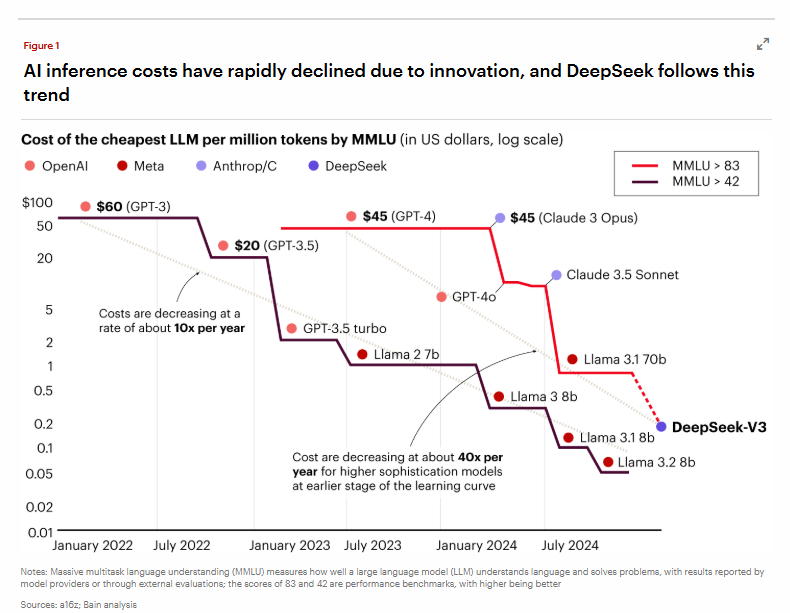
This is what everyone was freaking out about back in January 2025, when Chinese firm DeepSeek released a new AI model, R1, that claimed to be as sophisticated as the offerings of market leaders OpenAI, Meta, and Google while requiring less than one-tenth of the compute resources for training and also meaningfully improving inference efficiency. Nvidia immediately lost almost $600B of market value, the largest-ever one-day drop in the valuation of a public company, based on the idea that more efficient AI compute usage means fewer GPUs sold per unit of AI offerings trained and served to end users. While observers are still debating whether DeepSeek trained its model using more advanced off-the-books Nvidia GPUs (supposedly unavailable in China due to US export restrictions) and lied about the compute efficiency of its model, the broader takeaway is that it's very possible we see step-change improvements in AI model efficiency, rather than incremental improvements. Inference costs are coming down quickly - not just for DeepSeek, but for mainstream US AI models. Source: https://www.bain.com/insights/deepseek-a-game-changer-in-ai-efficiency/ The consequences of this for data centers, and therefore for energy project developers, would be very similar to those discussed in the previous section, with the difference being that here, AI proves its usefulness and profitability, but there’s still very little energy demand growth because more efficient AI models on a compute-per-model-trained and/or a compute-per-inference-query-served basis mean less compute is required than expected even as broad-based demand for AI-enabled products and services grows. This leaves us with the same result: Lots of underutilized data centers using less energy than projected or being shuttered entirely, and lots of stranded energy assets serving those data centers that can no longer sell enough electricity to pay back their debt and generate returns for their equity sponsors.
What If: Demand for electricity to power compute fails to continue growing rapidly as AI hardware becomes more energy-efficient?
At the risk of sounding like a broken record, the results of this would be very similar to items 1 and 2 – the difference is, again, in how it happens. Let’s say that AI companies do find and implement business models that create enough value for users (consumer or enterprise) to earn attractive margins, and that AI models don’t become meaningfully more efficient in terms of their compute needs per unit of AI demanded. The next link that could break in the causal chain has to do with the energy efficiency of compute.
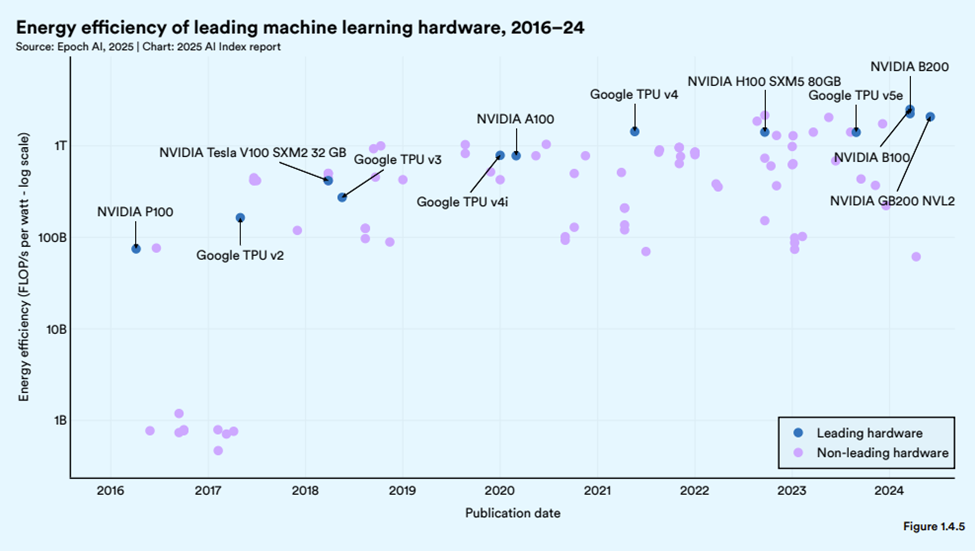
As measured in calculations performed per unit of energy use*, the market-leading Nvidia B100 GPU released in March 2024 was almost 34 times more energy-efficient than Nvidia’s P100 from back in April 2016, representing a CAGR of 55% ─ meaning a doubling of compute per unit energy about every 19 months. Now, that’s just one cherry-picked stat, and if you look at the chart below, you might notice an apparent slowdown in the growth of GPU energy efficiency over the last few years. Fine; maybe we “only” see 10-20% annual efficiency gains from here on out. But whatever number this ends up being, it’s almost certain that data centers deployed in the future will be more energy-efficient per unit of compute than those operating today – and if efficiency gains do continue to double every two or three years, that’s even more electricity that will be saved by new hardware to serve a given level of compute. Again, you can see where this is going: “Too much” advancement in GPU energy efficiency is another major threat to the conventional wisdom regarding AI-driven electricity demand growth, and therefore to the economics of energy projects developed to serve said electricity demand growth. Source: https://hai.stanford.edu/assets/files/hai_ai_index_report_2025.pdf#page=72 *Specifically FLOP/s, or floating point operations per second, per Watt of electricity. Yes, FLOP/s per Watt is a real unit of measure. Don’t worry if this name makes you giggle; I’m giggling too. We could also just call this metric FLOP/Joule, as Watts (demand) are just Joules (energy) per second (time, duh), so both terms in this division expression have seconds in the denominator, which cancel each other.
What if: The prior three what-ifs don’t occur, but the resulting AI-driven electricity demand growth is still just a drop in the bucket of overall electricity demand?
I’ll put some numbers around this concept in Part 2, but for now, assume with me that none of the prior what-ifs occur, everything "goes right," and most or all of the AI electricity demand growth we’re expecting to see materializes, at least through 2030 or so, such that energy project developers do have a solid reason to consider pivoting their business models to focus exclusively (or at least more narrowly than before) on serving AI data center offtakers. It’s highly possible that said AI-driven demand growth still only accounts for a fairly small piece of the overall electricity demand picture, based on three things:
AI electricity demand as a share of overall data center electricity demand
Data center electricity demand as a share of overall electricity demand
The contributions to demand growth of other electricity uses, like EV charging and industrial electrification
If this hypothesis is correct – if electricity demand growth from AI is at or close to the projections we’re discussed, but still doesn’t make much of an impact on topline electricity demand – energy project developers will need to ask themselves whether it makes sense to focus on selling energy to data centers to the exclusion of serving other types of off-takers whose demand may constitute a bigger slice of the demand growth pie. More on this to come.
I originally intended to squeeze this entire discussion into one blog, but as it’s getting lengthy, I’m going to end here for now. Stay tuned for Part 2, which will cover (or at least gesture vaguely in the general direction of):
The major uncertainties inherent in this forecasting exercise
How Goldman Sachs is arriving at their AI electricity demand estimates
What is driving GPU sales now, and when and how this may evolve in the future
A few juicy quotes from an industry expert, informed by the early-2000s dot-com bust
If any of this skepticism is believable, what’s an energy project developer to do about it?
This blog is written in my personal capacity and reflects only my own thinking, research, experience, and opinions.
This blog post is not sponsored by, endorsed by, or affiliated with my employer, although its content may be informed by some non-confidential aspects of my work.
This blog post is not investment advice and does not constitute any offer, solicitation to offer, or recommendation of any investment product or security.
This blog post is 100% human-drafted and edited. AI tools were not used in any way.
Want to weigh in with your thoughts? Propose a correction or improvement? Find me on LinkedIn or shoot me an email: cwetherbee at alumni dot gsb dot stanford dot edu.