Image credits: https://www.skysports.com/clint-dempsey (L) / https://www.npr.org/2017/03/08/518988840/wind-energy-takes-flight-in-the-heart-of-texas-oil-country (R) All discussion of “wind power” in this blog concerns onshore wind only.
Soccer Stardom in Football Country
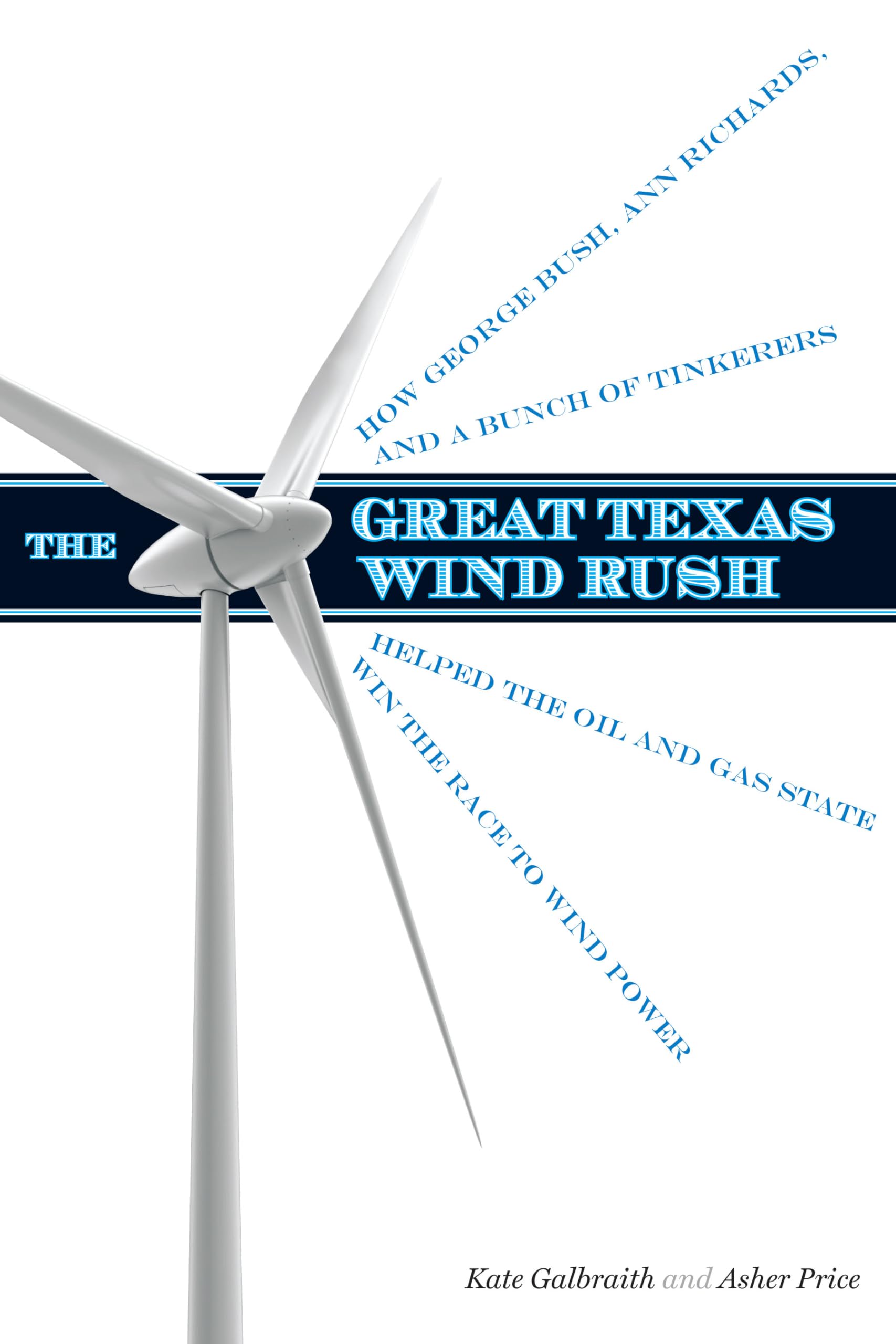
As I read Kate Galbraith and Asher Price’s 2013 book The Great Texas Wind Rush last month, I was thinking about football. Not the American variety that is the subject of near-religious devotion for so many in the Lone Star state, but the other kind, which for the sake of distinction I’ll call “soccer.” And the content of this book reminded me of one soccer player in particular – a native Texan, no less.
Veteran coach Bruce Arena once famously said of the legendary American forward Clint Dempsey, “He tries shit.” Over the course of his decorated career, Dempsey gained a reputation for grit, competitive fire, and most of all, for displays of skill and creativity on the ball. In an era of American soccer when the typical tactics were to run a lot, concede possession of the ball to more talented opponents, and try to steal a goal on the counterattack, Dempsey was that rare American player with the foot skills and risk appetite to play the beautiful game, well, beautifully – or at least interestingly. Not all of what he tried worked, but he tried it anyway, becoming one of the first American non-goalkeepers to succeed on the world stage and scoring 57 English Premier League goals over seven seasons at famed London clubs Fulham and Tottenham Hotspur.
Dempsey’s ascent to the top of the sport was an unlikely one. Hailing from Nacogdoches, Texas, he didn’t have the resources or pedigree of youth prospects coming through the European and South American academies that produce most professional stars plying their trade in the world’s best leagues. He grew up in the middle of nowhere, talked his way into an adult league at age fourteen, playing mostly with and against Mexican immigrants who helped shape the physicality and technique of his game, and later won that league's championship at sixteen before joining an elite Dallas-area youth squad that funneled him to college soccer and, eventually, the pros.
Image credit: Galbraith and Price
Wind Power in Oil Country
Like Dempsey’s story, The Great Texas Wind Rush contains themes of under-resourced, inexperienced underdogs improvising, tinkering, and eventually making it onto the big stage. They, too, “tried shit,” and eventually it worked. But of course there’s more nuance to the story than that. Unlike Dempsey, the Texas wind pioneers needed not just creativity and risk tolerance to achieve lasting success, but also strongly supportive public policy mechanisms, the likes of which had never before existed in a state notoriously hostile to government intervention.
Galbraith and Price’s multi-generational narrative begins in the 1960s with a brief description of Texas’s first (and the nation’s second) wind farm before jumping back in time to the water-pumping windmills and electricity-generating windchargers of the 1930s. After that, the story hops forward to the energy crisis of the 1970s and rolls more or less linearly from there up to the time of the book’s publication in 2013.
Rather than spilling too much ink on the book’s entire narrative arc and thesis, I’m going to share a semi-brief, skimmable table to summarize things and then move on to my commentary.
Coop’s Commentary: Three Key Takeaways
1. For emerging technologies, policy support starts as a “power button” and evolves into a “volume control.”
According to the book, Kenetech’s Texas Wind Power Project, the first utility-scale wind farm in the state, happened because:
a) The LCRA, a public utility, was willing to pay $60/megawatt-hour, above market rates at the time, to procure clean energy and fund required transmission upgrades to deliver it, and
b) The federal Production Tax Credit (PTC) effectively juiced revenues by an additional $15/MWh.
In other words, a combination of forward-looking utility executives (those in the industry know this phrase is almost as self-evidently paradoxical as, say, “rude Canadian” or “gourmet dry cat food”) and supportive federal policy incentives flipped the switch from “off” to “on” for the Texas Wind Power Project and others like it in the late 1990s. As the industry grew, turbines became cheaper and more durable, and best practices for development, construction, financing, and operations emerged, policy support transitioned from being a binary determinant of wind deployment to merely an accelerator. Today, following the repeal of the Inflation Reduction Act via the OBBB, and with it the elimination of the longstanding PTC for wind projects (along with the elimination of the newer solar PTC, and the ITC for both technologies), it’s important to understand this.
Wind projects certainly benefited from the IRA’s $27.50/MWh, 10-year PTC incentive: By my calculations, the IRR uplift from PTC for the equity sponsor was about 300-450 bps, depending on your tax equity/ tax credit transfer assumptions and other project-specific inputs. However, some projects still can and will get built if the tax credits go away: With onshore wind capital costs having settled at around $1,700/kW (including transmission upgrades) plus another $20MM or so in other project delivery costs, a 300 MW project with a 40% net capacity factor, levered at 65-70% (based on a 1.3x debt service coverage ratio, or DSCR) with debt priced at SOFR + 200 bps (or about 6.5% as of today), assuming merchant revenues of around $40/MWh (real 2025$) upon PPA expiry, needs to hit a target 20-year PPA price of about $55/MWh to reach something like a 10% equity return. Whew. Long sentence there.
All of those numbers are back-of-the-envelope, but they’ll do for our purposes here. That 10% is a fairly skinny return figure, and in a post-PTC world it largely depends on achieving higher merchant capture prices and PPA rates than what we are seeing today. But higher electricity prices are very likely to materialize post-OBBB given rapid recent and forecasted demand growth, widespread retirements of older thermal capacity, and a 5-year order backlog for new gas turbines. In this context, some amount of renewable projects can still offer a compelling contracted price to the big tech firms and other corporate electricity buyers who account for much of the demand for renewable energy, and therefore still find a way to get built. Of course it would have been much better for the industry and for general decarbonization efforts to preserve PTC entirely or phase it down over several years, but at this point the effect of eliminating tax credits on renewables deployment is more like turning down the volume dial (to be clear, WAY down with the passage of OBBB) than flipping the off switch.
There will be serious consequences to this policy change: Many (most?) of today’s early-stage renewables projects targeting late-2020s CODs won’t be financially viable if they mature after ITC and PTC expiration (SOC by July 4, 2026 and PIS within 4 years of SOC, or PIS by the end of 2027), unless we see a massive increase in off-takers’ willingness to pay for PPAs. A lot of people in the industry will lose their jobs. A lot of investors will lose their money. This is all bad if your goal is to deploy as much clean energy as quickly as possible. However, this downturn won’t kill the industry outright: Once the tax credits are gone, the strongest projects, with advantages on items like capex, wind resource (i.e. projected capacity factor), nodal economics, and/or network upgrade costs, will still get built and make good money for their owners. Capital cost learning curves, project development expertise, and creative financial structuring solutions all flourished in the years following initial government support back when said support was a requirement, not merely an accelerant, for renewable energy deployment to occur, and now the industry has the scale, capabilities, and institutional knowledge to survive in a post-tax credit era – even if it’s harder to thrive than it was when the IRA and its precursor tax credit regimes were still in full effect.
With wind and solar power now mature industries, attention is starting to shift toward deployment of the next tranche of clean energy technologies. As the industry looks to supplement rising solar and wind grid penetration with clean-firm solutions to keep the lights on (and the data centers humming) at all hours, what kind of policy support mechanisms are required to help emerging technologies like long-duration energy storage (“LDES”: Form, Antora, Noon, Malta, Rondo) and geothermal (Fervo, Quaise, Sage) deploy and come down the cost curve more quickly? To be clear, “policy support” need not be tax credits or subsidies; certain adjustments to power market design could be even more impactful. Almost everyone I’ve spoken to about LDES says the main barrier to grid-scale projects is that today’s ISO/RTO market structures don’t recognize the value of a 48-hour battery to the grid. And yet, in the abstract, we can all say with a certain amount of confidence that there’s a substantial gap between the very near-term incentives set by day-ahead and real-time energy markets, and the longer-term incentives set by year-ahead capacity markets. The creation of new multi-day reserve products in markets like PJM and MISO could bridge this temporal planning gap and help keep the lights on during extreme weather events, which thanks to meteorological advances we can now forecast with pretty good accuracy several days in advance – enough time to charge massive LDES systems that can then backfill any gaps in generation from either renewable or thermal resources until the heat wave or hurricane has passed. So, wholesale power markets (and vertically integrated utilities, too, if you dare): Get on this!
2. Transmission has become the main non-policy bottleneck to wind deployment.
A lot of this book is devoted to showing us the multi-decade growing pains of the Texas wind industry in three main areas:
Manufacturing cheap, reliable, durable turbines.
Getting someone to buy the power they produced.
Finding policy support to make the economics work out.
Until wind developers figured out these three issues, nothing else was relevant. Once they did, the focus shifted to tying up suitable land for project development, which meant identifying areas with good wind speeds and access to sufficient transmission to deliver the power to demand centers.
Before OBBB’s passage a few weeks ago, this last challenge, transmission, had become the gating factor in the US preventing the deployment of renewable energy (both wind and solar) at a sufficiently rapid pace to slash power-sector carbon emissions while meeting fast-growing electricity demand from AI, EVs, and industrial electrification. Now, as the phase-out of tax credits means developers can no longer justify developing at anything other than a very strong node with minimal upgrade costs (again, assuming limited off-taker appetite to pay more for a PPA), this is even more true. The Great Texas Wind Rush previews this with its discussion of the Competitive Renewable Energy Zones (CREZ) program, a $6.8 billion expansion of ERCOT’s high-voltage transmission network in West Texas and the Panhandle, but the book was written before CREZ was completed, so allow me to fill in the rest of the story: CREZ worked for a while, until all of that additional east-west capacity was claimed by new projects, and now we’re back in the same place we were fifteen years ago, imploring the grid operator to beef up the high-voltage transmission network. ERCOT has generally been unresponsive to these requests until very recently, when its Regional Transmission Plant proposed building a few new 765-kV lines in response to demand growth driven by both the buildout of AI data centers and the electrification of oil and gas drilling operations in the Permian Basin.
In a transmission-constrained environment, successful project siting and development depend on developers’ ability to identify uncongested points of interconnection (POIs) on the grid and and tie up land nearby. The idea is to target areas where sufficient injection capacity exists to ensure the project can sell its energy into the market without suffering from negative pricing events when local supply far outstrips demand. Of course, expanding transmission is (with apologies to Kevin Costner and James Earl Jones) an “if you build it, they will come” situation, or, as economists and highway engineers call it, induced demand: The more transmission you build, the easier it is to interconnect a new project, and the more projects get built, eventually gobbling up all of that additional capacity until the lines are once again fully utilized. But here, since we expect rapid electricity demand growth that can’t be met unless we build a lot more projects, this is a good thing! So – Texas and everywhere else – if you want abundant, affordable electricity, build more big long-distance transmission lines ASAP.
3. Show us the development grind!
For all of its encyclopedic coverage of the personalities, policies, and locations that shaped the growth of Texas’s wind energy industry, the book is largely lacking in coverage of one key area: The multi-year development process that occurs between site control (signing of a lease or lease option at the proposed project location) and construction start. During this time, the project developer must do several phases of engineering and design work, refresh its outlook on local injection capacity and transmission constraints, advance various permitting and legal processes, navigate any potential community opposition from people opposed to the project, and raise financing for construction. As the project achieves key milestones over time, its probability of completion increases, while if it fails to achieve any of these milestones or suffers significant delays, especially early on in the process, the developer will likely cut their losses and discontinue development.
As I mentioned, the book covers the R&D, manufacturing, site acquisition, and energy offtake aspects of the wind industry. However, it doesn’t really get into the nuts and bolts of project development after site control is obtained. Perhaps my work buying, selling, and developing pre-construction renewables projects has made me a glutton for punishment, but I wanted to hear more about the title insurance fumbles, mineral rights mishaps, and interconnection queue dramas that no doubt plagued the first wave of Texas wind projects before the shovels went into the ground. My college baseball coach loved to say, “Life’s too short to learn from your own mistakes, so you have to learn from other people’s.” In that spirit, I would have appreciated the opportunity to learn from the mistakes of the Texas wind pioneers and understand how their early experiences contributed to the emergence of certain best practices that we may take for granted today. To be fair, this book was written for a general audience, not for industry professionals, and it is a well-researched, entertaining read for folks less familiar with (or less interested in) some of the nitty-gritty details of project development.
Final Thoughts
Twelve years on from its initial publication, The Great Texas Wind Rush holds up quite well as a deeply researched and painstakingly crafted narrative spanning the history of wind energy in Texas. While at times the book focuses too much on a few individual personalities at the expense of a greater level of insight into equally relevant processes and institutions, it is entertaining, informative, and a great entry point for general audiences seeking to understand Texas’s role in the global growth of wind power. I can only hope that one day, someone will publish an equally insightful work covering Clint Dempsey’s influence on the world of American soccer. Until then, it’s back to the YouTube highlight videos.
★★★★☆
(4/5 stars)
If you’re interested in reading the book, check out your local library or click here to buy a copy.
Standard Disclaimers
This blog is written in my personal capacity and reflects only my own thinking, research, experience, and opinions.
This blog post is not sponsored, endorsed by, or affiliated with my employer, although its content may be informed by some non-confidential aspects of my work.
This blog post is not investment advice and does not constitute any offer, solicitation to offer, or recommendation of any investment product or security.
This blog post is 100% human-drafted and edited. AI tools were not used in any way.
Want to weigh in with your thoughts? Propose a correction or improvement? Find me on LinkedIn or shoot me an email: cwetherbee at alumni dot gsb dot stanford dot edu.