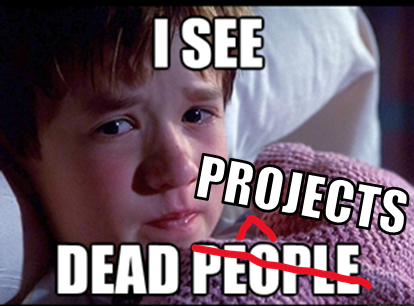
81 GW of dead projects, to be specific. Yikes. You don’t need a Sixth Sense (ha) to know that the recent budget reconciliation bill is bad news for US renewables developers and investors at a macro level. Like a Shyamalan movie, the process of this bill has been a suspenseful and scary ordeal followed by some disappointing plot twists at the end that made us all wonder why we even bothered to sit through the whole thing. Now that it’s done, how are the policy changes enacted by the bill going to ripple through the business of project development at ground level? My three probably-not-that-bold predictions about what’s in store for those of us strapped into the Solar Coaster:
Procurement is everything (again).
The Great Consolidation continues to accelerate.
Differentiate or die.
Read on for the full blog post and let me know what you think.
A Very Recent, Very Abridged History of OBBB
“Glide path.”
“Rug pull.”
“Own goal.”
These pithy phrases, and many more like them, have been flying around lately as the Republicans’ One Big Beautiful Bill Act (hereafter, OBBB) boomeranged from the House to the Senate and back, picking up and dropping several clean energy-related provisions along the way before passing and being signed into law on July 4th. So, what did we end up with – and how bad is it for the US renewables industry?
First, let’s rewind a bit. Things looked especially dire over the last weekend of June, when the Senate Finance Committee released an updated mark of the bill that would have drastically accelerated the clean energy investment tax credit (ITC) phase-out from what was initially proposed in the House version, and also added an arbitrary, punitive post-2027 excise tax on renewable energy projects using components from China (which almost all projects do based on where critical minerals processing and component production are located). Jason Grumet, the head of the American Clean Power Association, called this language “so carelessly written and haphazardly drafted that the concern is it will create uncertainty and freeze the markets.” Look, this is a guy hired by his industry (also my industry!) to go lobby for policy support on the Hill, so take it with a grain of salt. But the argument isn’t (only) that this outcome would have been bad for renewables from an economic standpoint. Grumet was specifically taking issue with the drafting – the fact that whoever wrote this excise tax provision clearly doesn’t understand the industry and its supply chain, and likely doesn’t care enough to do their homework, as long as the bill is hurting the right people. We can go back and forth on whether making life generally harder for the renewables industry is good or bad policy, but it’s absolutely bad governance to advance policy goals with lazy, slapdash language that makes it impossible for investors and businesses to understand how the new law will be implemented and enforced.
Thankfully, I can get off my high horse, at least in this specific case: The final bill text, implemented via a broad “wrap-around” amendment in the Senate, passed by the House, and signed into law by the President last week, nixed the excise tax. It also modified the ITC phase-out such that large-scale solar and wind projects can only claim the ITC if they meet one of these two criteria:
Start construction (SOC) by July 4th, 2026, and are placed in service (PIS) within four years of SOC.
Are placed in service (PIS) by December 31st, 2027.
That’s somewhat worse for renewables than the multi-year, progressive ITC phase-out proposed in a prior version of the House bill, but far better than the would-be twin hatchet jobs of the text that initially passed the House (SOC within 60 days of bill passage to qualify for ITC) and last weekend’s Senate markup (Very quick ITC cutoff date + punitive excise tax). Just how bad is it relative to the original text of the IRA? Well, sharper minds than mine have already engaged with this question ad nauseam and concluded that, compared with a business-as-usual (i.e, IRA remains in place) case, we’ll likely see an 81 GW reduction in utility-scale renewables deployment through 2033, reducing private energy transition investment by $141B, both relative to the IRA baseline, while increasing US energy costs by $50B/year in 2035. If you’re interested in the details behind those estimates, check out David Riester and Paul Hildebrand’s excellent series here as well as Jesse Jenkins's most recent figures here.
With those very ugly topline numbers in mind, how is this going to play out on the ground? Let’s walk through a few key ways in which life for developers and investors will change in the very near term as a result of this bill's passage. Here are three big themes to chew on for those of us working in renewables development and investing, post-OBBB passage:
1. Procurement is everything (again)
During COVID-19 much of the world's manufacturing and shipping capacity was temporarily shut down or drastically reduced, causing spiraling supply chain backlogs throughout the entire renewable energy sector – especially for critical power electronics like transformers and breakers, which were subject to lead times as long as two years back in 2021 and 2022 (and haven’t improved much since then). Modules had their own share of supply bottlenecks, of course, but power electronics were and continue to be the bigger barrier to getting projects built and plugged in on time. When you can’t get the transformer that you need so the utility can connect you to the grid, you're going to blow through sensitive interconnection deadlines, put big deposits paid to the utility and to your PPA off-taker at risk, and maybe even kill your project entirely before the shovels go in the ground. So this is hugely important stuff for the industry.
And now… get ready to do it all over again. While lead times for this stuff have eased slightly since the height of COVID as supply chains have recovered, manufacturing capacity bottlenecks still exist and will only be exacerbated by a new wave of developers rushing to “safe-harbor” their projects via SOC. Because the end-of-2027 PIS deadline is basically tomorrow in project development terms, smart developers will instead be looking to start construction by July 4th, 2026 to lock in ITC qualification. Historically, SOC could be achieved for a given year in two main ways:
Spend at least 5% of total facility cost in that year. Straightforward, simple.
Commence physical work of a significant nature in that year. This could be offsite or onsite work, and could include the manufacturing of custom components or preliminary site work like building access roads as well as the actual installation of racking, panels, and collectors.
For now, these two options still apply – but according to several House Republicans who threatened to withhold their votes, the President convinced them to support the bill by promising to crack down on renewable energy tax credits through executive orders. This tightening of the screws, if it happens, would likely be accomplished by ordering the IRS to issue new guidance establishing a stricter standard for SOC, which could mean a higher percentage of capex spent and/or more specific, harder-to-meet requirements for the types of onsite and offsite work that count as bona fide “physical work.”
UPDATE THAT SPEAKS POORLY OF MY TIMELINESS IN EDITING AND PUBLISHING THIS BLOG: The above paragraph was drafted before the administration issued an Executive Order on July 7th that tries to do exactly what I predicted. Should have hit publish sooner! Note that the OBBB text explicitly references the prior IRS guidance on SOC as the standard to be applied for ITC qualification (click here, navigate to the PDF, and see Beginning of Construction language on pages 189 and 194), albeit potentially subject to additional guidance. The administration may or may not have the formal authority to change the SOC definition… but they’ll sure try regardless. See you in court, I guess.
What all of this means is that developers’ procurement and execution teams will have to weigh the relative risks and benefits of limiting capital exposure by spending the current minimum amount required to hit SOC well before a broader scope of construction activities begins at full notice to proceed (FNTP), versus buying and/or installing more equipment than “usual” right away to ensure they achieve SOC even if the SOC threshold increases based on new, more restrictive IRS guidance. For the shops that are well-capitalized enough to splash some cash on additional equipment orders and/or more extensive pre-NTP site work to meet an anticipated higher SOC threshold, it’s go time. I expect equipment manufacturers’ phones will be ringing off the hook in the weeks and months ahead, with order books and delivery dates backing up all over again. For those who can’t afford to do this… Well, read on.
2. The Great Consolidation continues to accelerate
For a lot of reasons – increasing interconnection deposit amounts due earlier in the project lifecycle; extreme cost competition to tie down lease options on desirable parcels of land; higher interest rates translating to higher sponsor IRR hurdle rates even as projects receive less returns uplift from leverage; a cooling market for early- and mid-stage development pipeline acquisitions as big IPPs and strategics have shifted from building 20-bragawatt pipelines to executing on their best projects – develop-and-flip shops are struggling right now. The full story behind the squeeze that’s been driving these smaller development shops out of business and consolidating power among industry’s heavyweights is a tale for another time, but the point is that the passage of OBBB will accelerate this trend even further.
Why is this? Well, as discussed above, if you can’t achieve SOC on a project by July 4th, 2026 to lock in ITC, and if the returns on that project don’t pencil without the tax credits, then that project is dead. This is true for almost all projects right now; in the long run project returns will start to pencil without the ITC to the extent that 1) capex further decreases in the future as the solar module learning curve continues (assuming punitive import tariffs on key equipment don’t last – may we be so lucky) and/or 2) developers succeed in finding off-takers willing to pay substantially more, let’s say an extra $10-25/MWh, over the life of a 20-year PPA. But right now, dead, unless you manage to sell your project to someone else who wants to spend that money to achieve SOC.
Even in that case, your buyer is taking all of the risk of ordering equipment and probably also originating a PPA, and therefore adding all of the value. If they know that the project dies if you’re still holding it at this time next year (or next quarter, if you have a ticking clock on interconnection agreement execution and security deposit posting to preserve your target COD), and they know there are hundreds of projects in each ISO/RTO (especially ERCOT) that look just like yours, what incentive do they have to pay you a substantial development fee? Maybe they throw you a reimbursement of development costs to date at the closing of the acquisition and a cent or two a watt when the project hits NTP. Maybe. Those aren’t the economics that got you excited about the development business model if you’re a develop-and-flip shop that takes a capital-light, skeleton-crew approach to greenfielding and aims to sell projects pre-NTP, before costs really ramp up. So a lot of those folks will be forced to sell their projects for peanuts or kill them outright before likely exiting the business in the near to medium term.
Looking past the “two guys, a dog, and a truck” developers (I first heard this industry-standard phrase in the class of Stanford lecturers and renewables legends Jeff Brown and Dave Rogers), there may also be a whole world of hurt coming soon for developers with somewhat greater financial resources and larger teams – potentially including even a few established, PE-backed names – that still lack the scale to both advance a geographically diversified pipeline and achieve critical efficiencies in financing and operating large project portfolios. Many of these firms had originally planned to either construct a limited set of projects and become “mini-IPPs” owning and operating just a few hundred megawatts, or find financing partners to help them fund construction of a whole bunch of projects, then sell down their remaining stake in the portfolio post-COD to recycle capital and fund their next wave of greenfield origination. But when you’re only developing eight projects at a time and then have to figure out how and whether you can afford to build your favorite three (after killing the other five), you’re going to have a tougher time raising the kind of capital necessary to achieve SOC on any given project, because your bets are so concentrated.*
This is especially true if you’ve focused on developing within a single market, and doubly so if, god(s) help you, that market is Texas. I’m sort of repeating myself here, but relative to other markets, it’s very easy and cheap to get interconnected in ERCOT as long as you can plunk down the multi-million-dollar interconnection security deposit (I may write more about how developers handle these deposits in the future) or sell out earlier to someone who can. This means the queue is absolutely jammed with bad to average projects whose local developers think (hope?) they are good projects. These ERCOT-only developers are fully exposed to risks inherent to the Texas market, like anti-renewables legislation, capture prices that are dropping off a cliff, and low barriers to entry for the competition eyeing up a piece of land down the road that could connect to the same substation you’ve applied for. Bye-bye, preliminary injection capacity and nodal basis forecasts!
This is not intended to be a rant against ERCOT. PJM, MISO, and all of the other markets each have their own headaches and bottlenecks. The point is that diversification across geographies is value-additive for a developer because it helps mitigate the risks associated with any one market. With a 6 GW pipeline of projects across three or four ISOs maturing over the course of several years, you can confidently put in an order for 3 GW of panels and several transformers, knowing that even if your entire 1.5 GW ERCOT portfolio dies on the vine because of terrible policymaking (a constant threat; here’s a recent near miss) or some other market-specific risk factor, you’ve still got 4.5 GW on track to reach NTP in PJM and MISO, albeit likely a few years later – so you can achieve SOC on a different set of projects with the equipment you’ve procured and lock in ITC for those projects, ensuring they stay economically viable.
Cultivating this broad of a pipeline is expensive, and if you’re truly committed to building and owning renewable projects rather than just originating and flipping them as quickly as possible, the development and construction costs ramp up years before you get any money back – even more so now that there’s a rush to start construction for ITC qualification purposes. This underscores the importance of having a strong existing balance sheet (like publicly-traded NextEra) or a deep-pocketed, patient, and sophisticated private equity sponsor willing to be greedy when others are fearful (like Brookfield, GIP, or Blackstone) to create and capture value as a utility-scale developer.
In addition to enabling geographical diversification, being really big allows mega-developers to achieve cost and capability efficiencies through vertical integration. This means you can justify hiring full-time, in-house employees who specialize in stuff like EPC management, powerflow/basis/curtailment analysis, applying to off-taker RFPs, and procuring equipment – all areas in which smaller, cheaper develop-and-flip operations generally have to hire consultants or otherwise seek external partnership to achieve a similar level of end-to-end sophistication throughout the development cycle. If you have the funds and judgment to hire and retain the right team as a vertically integrated developer, you have a much better opportunity to capture some of the advantages shown in the table below (so read on to my third point!).
*Let’s be clear that for the purposes of this blog, I’m only contending that “big is beautiful” for utility-scale developer platforms – it’s significantly cheaper (but not necessarily easier!) to develop, own, and operate a diversified distributed solar and storage portfolio, since smaller projects and check sizes allow for more portfolio diversification per dollar spent.
3. Differentiate or die
I’ve argued above that scale is basically a must to mitigate portfolio concentration risks and build a valuable renewables development platform. But while it may be necessary, scale alone is no longer sufficient. Even with a big war chest to staff up, secure site control, progress project development, post interconnection and PPA deposits, and preorder equipment, there’s no guarantee that you’re actually finding and executing upon high-quality projects – or that you’re adding any value to them in the development and commercialization process. The developers that survive the Great Consolidation and thrive afterward will be the ones that understand and play to their unique advantages. What could such a competitive advantage look like? A few ideas: I’m sure I’ve missed plenty of other ways a renewables developer can achieve differentiation in today’s market, and I invite you to throw in your two cents – how else can developers set themselves apart? My overriding takeaway: With project economics set to take a nosedive and plenty of zombie projects clogging the interconnection queues, you’ll need some kind of special sauce to come out on the other side with cash in your pocket and your projects achieving COD as the entire US renewables industry sails into gale-force policy headwinds over the next few years. So figure out where your advantage is (or could be) and start executing on it, right away.
Standard Disclaimers
This blog is written in my personal capacity and reflects only my own thinking, research, experience, and opinions.
This blog post is not sponsored, endorsed by, or affiliated with my employer, although its content may be informed by some non-confidential aspects of my work.
This blog post is not investment advice and does not constitute any offer, solicitation to offer, or recommendation of any investment product or security.
This blog post is 100% human-drafted and edited. AI tools were not used in any way.
Want to weigh in with your thoughts? Propose a correction or improvement? Find me on LinkedIn or shoot me an email: cwetherbee at alumni dot gsb dot stanford dot edu.